[ LAB OPERATIONAL DIRECTIVE ]

The Lab operates on a 90-day Quarterly Extraction Epoch. All ledger allocations are synchronized within this seasonal dispatch horizon and utilize Volumetric Aggregation to fill a shared Standard Tectonic Unit (20ft). Mandates unfinalized prior to termination defer to the following cycle.

Dedicated STU Mandates: Bypass collective sequence constraints with priority oversight and isolated dispatch.

[ CURRENT SEQUENCE TERMINATION ]

Dismiss

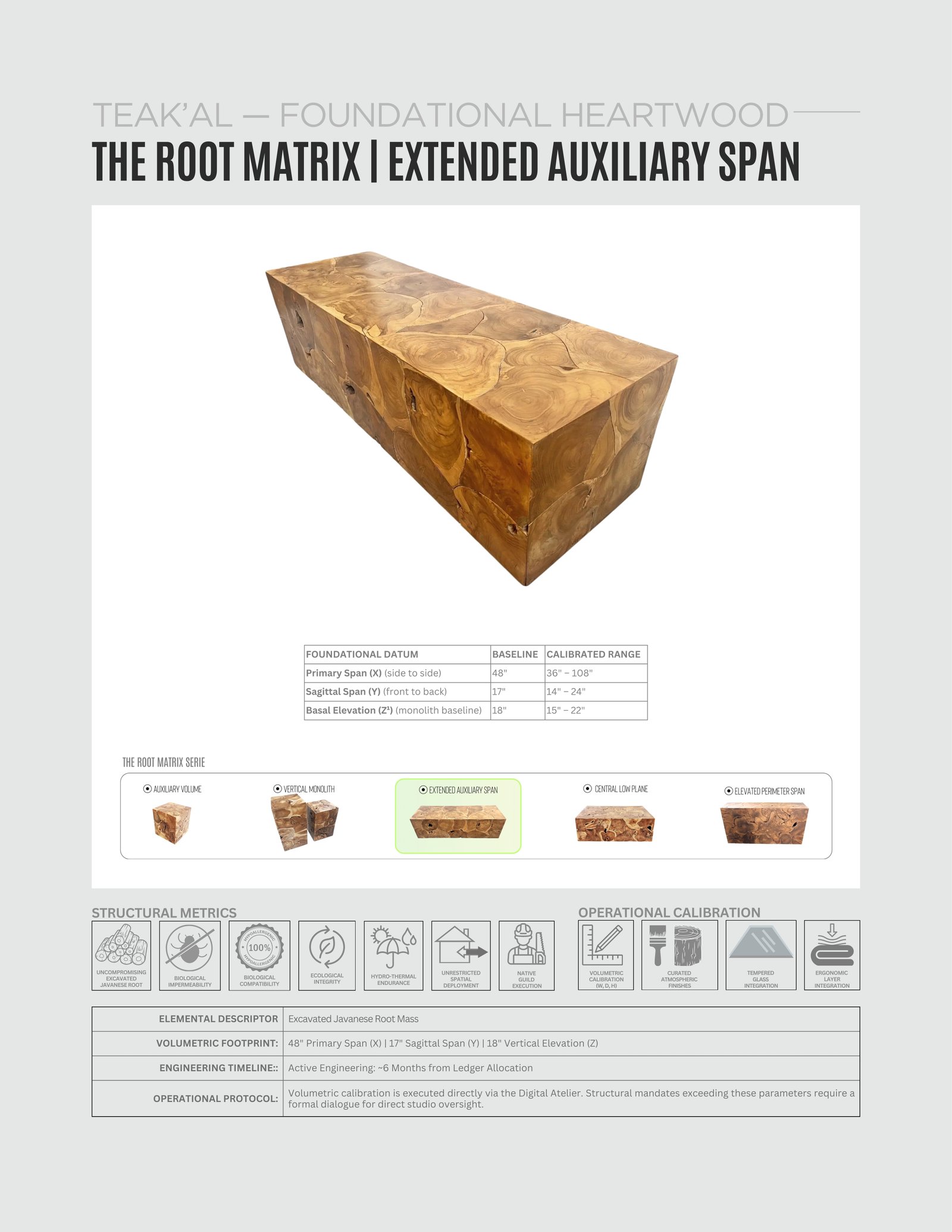
The Root Matrix | Extended Auxiliary Span

Linear horizontal monolith engineered through a thermal lamination matrix of fused Grade-A heartwood root sections, utilizing mitered geometric boundaries to transform subterranean biological irregularity into a disciplined architectural datum.

Available on backorder

Calibration Protocol
Digital Atelier: Specification Protocol
Dimensional calibration is achieved through the parameters defined below. Autonomy is granted to define the artifact's spatial displacement within established structural limits.
→ Calibration Parameters
Maintain default indices for the standard foundation typology.
Calibrate specific dimensions to harmonize with your exact physiological scale and the spatial volume of your biological baseline.
Audit & Principal Oversight
For requirements exceeding these parameters, the Principal Alchemist provides direct 1:1 oversight.
Native | Structural | Generational | Heartwood
Spatial Autonomy
Foundational Datum Baseline Calibrated Range
Primary Span (X)
(side to side)
48" 36" – 108"
Sagittal Span (Y)
(front to back)
17" 14" – 24"
Basal Elevation (Z¹)
(monolith baseline)
18" 15" – 22"
Tactile Offset (+Z)
(optional enhancement)
+1" variable (+1" to 10")
Atmospherics: The Finish Calibration
Utilizing the uncompromising performance of Grade-A native heartwood, the specified finish serves as a definitive operational layer—calibrated to the exact environmental volume of the biological baseline.
A finish is a clinical stage of active engineering. From multi-stage abrasive calibration to the precision application of organic spectrums, each treatment secures the material honesty and architectural intent of the heartwood.
Whether mandating a high-frequency saturated integration or the mineral depth of an alabaster typology—or a composite calibration like Alabaster Saturated—each finish is engineered for a specific spatial mandate.
Native Raw remains the foundational standard for its unrestricted structural versatility and long-term material stewardship.
The Material Violation: The Eradication of Heartwood
The application of synthetic pigments to Grade-A heartwood is a structural failure.
Heartwood is a living conduit—it regulates its internal lipids and silica in rhythm with the environment. Sealing this biological volume under paint chokes the structural integrity, leading to accelerated material decay.
Its golden-brown density is not meant for confinement. Masking the grain erases the geological truth of the origin.
Instead, specify curated atmospheric finishes that maintain material honesty—preserving the strength and generational weight of the biological volume.
Institutional Note: This protocol refers strictly to heartwood; sapwood typologies lack the natural density required for exposed finishes and are excluded from our primary dossiers.
Structural Deviations: Organic Form Integration (e.g., Roots)
Absolute Form Preservation: Calibrations for organic root typologies utilize minimal surface preparation to ensure consistent absorption while maintaining the raw architectural form.
Tactile Honesty: Precision finishing maintains the grain patterns and knots of the organic structure, ensuring the sculptural weight remains the primary spatial focus.
Structural Finality: The result is a refined integration that complements the architectural volume without compromising the origin of the material.
Institutional Protocol: These directives apply specifically to products crafted from roots or branches, where traditional Grade-A heartwood classification shifts to an assessment of tree maturity and geological density.
Operational Intelligence
Material verification is a foundational requirement. Identifying the exact heartwood grade preserves capital and ensures generational permanence.
Retail misrepresentation of 'teak' without specifying its biological grade (A, B, or C) disrupts the execution of a biological volume. Whether mislabeling sapwood or citing regional proxies (e.g., 'Philippine' or 'Brazilian' teak), these labels signal a lack of material honesty. Teak'al maintains a strict origin protocol, overseen by the Principal Alchemist.
Specifying Grade-A Heartwood is a commitment to the most resilient elemental material on earth.
Grade A: The innermost 35% of the tree—the high-density heartwood, saturated with native oils for absolute durability.
Grade B: The outer heartwood or immature timber. Reduced silica content and compromised structural integrity.
Grade C: Sapwood—porous, prone to decay, and architecturally non-viable.
The Standard of Excellence
Uncompromising Durability: High silica and lipid content mitigate thermal variance, warping, and saturation damage.
Elemental Shielding: Native tannins provide biological protection against mold, UV degradation, and pest intrusion.
Chemical-Free Regulation: The material self-regulates moisture, ensuring an eco-friendly integration into any environment.
Teak'al utilizes 100% premium Javanese Grade-A heartwood—never reclaimed, never compromised.
Specification of Material Atmosphere
Each treatment is curated to enhance the performance and material truth of the heartwood. These parameters are engineered for generational time. Review the structural dossier below for performance metrics and finish classifications.
Operational Performance Criteria
Operational Factor Architectural Metric
Hydro-Thermal Endurance Shields against moisture saturation—essential for atmospheric stability and outdoor environments.
Friction Coefficient Maintains a non-slip surface, critical for high-moisture typologies and marine integrations.
UV Mitigation Prevents pigment degradation from sun exposure, ensuring long-term spatial resonance.
Stewardship Efficiency Indicates the operational ease of cleaning and material restoration over time.
Structural Integrity Reflects the material lifespan under daily wear and environmental stress.
Stain Resistance Repels marks and spills to maintain the visual integrity of the volume.
Abrasive Resistance Measures the ability to withstand surface scratches from daily interaction.
Spatial Resonance Enhances visual weight while complementing the overarching architectural intent.
Tactile Honesty Describes the haptic feel—clinical, organic, or heartwood-enhanced.
Ecological Integrity Rates sustainability, material origin, and environmental footprint.
Institutional Finish Ledger
Typology Operational Intent Frequency / Sheen Endurance Friction UV Shield Stewardship Integrity Abrasive Stain Resonance Texture Ecological Score
Native Raw Pure heartwood for raw, organic intent. Ideal for all volumes, allowing for natural aging. Smooth, Matte Absolute Absolute Superior Absolute Absolute Absolute Superior Absolute Absolute Absolute Absolute Integration
Native Encapsulated Preserves original tone while adding a structural shield. Suitable for high-exposure volumes. Smooth, Satin Absolute Superior Absolute Absolute Absolute Absolute Absolute Absolute Absolute Absolute Absolute Integration
Carbon Raw Enhances pigment depth to match complex calibration mandates. Ideal for internal volumes. Rich Tone, Semi-Gloss Absolute Absolute Superior Absolute Absolute Absolute Superior Absolute Absolute Absolute Absolute Integration
Native Saturated Deepens tone and nourishes heartwood for maximum hydro-thermal endurance. Natural, Low Sheen Absolute Absolute Absolute Superior Absolute Absolute Superior Absolute Absolute Absolute Absolute Integration
Alabaster Raw Softens tone for mineral-inspired aesthetics. Ideal for bright internal volumes. Soft, Matte Superior Absolute Superior Superior Absolute Superior Superior Absolute Absolute Absolute Structural Standard
Carbon Encapsulated Combines pigment depth with an enhanced structural seal for elite environments. Smooth, Semi-Matte Absolute Superior Absolute Absolute Absolute Absolute Absolute Absolute Absolute Absolute Absolute Integration
Carbon Saturated Blends tone with an oiled finish for sophisticated interior volumes. Warm Glow Absolute Absolute Absolute Superior Absolute Absolute Superior Absolute Absolute Absolute Absolute Integration
Alabaster Encapsulated Lightens the material while providing structural durability for interior and exterior volumes. Smooth, Satin Absolute Superior Absolute Absolute Absolute Absolute Absolute Absolute Absolute Absolute Absolute Integration
Alabaster Saturated Softens the material while providing deep nourishment and elemental protection. Matte, Smooth Absolute Absolute Absolute Superior Absolute Superior Superior Absolute Absolute Superior Structural Standard
Summary of Typologies
Typology Architectural Intent
Native Raw Preserves heartwood in its purest form, offering raw organic weight and graceful material aging.
Native Encapsulated Maintains original pigment with an institutional shield that enhances material resilience.
Carbon Raw Deepens heartwood tones for an authoritative finish while maintaining a subtle operational layer.
Native Saturated Enriches the grain with mineral depth while preserving natural lipids and long-term durability.
Alabaster Raw Delivers a soft, sun-washed aesthetic for coastal mandates without compromising material weight.
Carbon Encapsulated Provides a refined, high-end finish with an added structural seal for elite environments.
Carbon Saturated Blends deep pigment with haptic smoothness, offering both authority and generational protection.
Alabaster Encapsulated Pairs a sun-faded aesthetic with structural durability, shielding against moisture and fading.
Alabaster Saturated Combines mineral-inspired tone with deep nourishment for a hydrated and resilient sanctuary.
Operational Preservation & Stewardship
Material Stewardship Operational Protocol
Native & Saturated Typologies Sanitize with pH-neutral agents and water, followed by immediate moisture mitigation. Preserve natural lipids.
Carbon & Alabaster Typologies Minimize saturation to maintain the intended pigment depth. Use specialized tools for material stewardship.
Outdoor Deployment Utilize breathable architectural covers when dormant to shield the heartwood from UV variance and environmental stress.
Internal Volume Stewardship Routine stewardship and environmental regulation preserve the material in prime condition. Avoid direct thermal sources.
General Protocol Address spills immediately. Utilize only wood-safe, institutional-grade cleaners to preserve the structural finality.
Finish Selection: The Labor Tiers
Foundational Protocol (Baseline)
The Lab signature calibration (Native Raw). Achieved through multi-stage abrasive-milled micro-sanding to achieve tactile honesty and a silky, zero-friction interface. Native Raw preserves the wood's organic respiratory function.
Institutional Setup Floor: Included
Refined Protocol (15%)
Atmospheric resonance achieved through triple-pass hand-rubbed saturation. This protocol accounts for a 72-hour stabilized curing period, ensuring total molecular integration and baseline lipid preservation.
Institutional Setup Floor: $150.00
Exclusive Protocol (25%)
Engineered for absolute spatial finality. Utilizing a six-pass integration sequence with climate-controlled maturation for 144 hours. Designed for extreme environments where temporal density is required.
Institutional Setup Floor: $250.00
Institutional Protocol: Organic Form Typologies
For artifacts utilizing roots, trunks, or branches, the sanding sequence follows a Hybrid Calibration. While primary contact surfaces are hand-sanded to absolute tactile smoothness, specific structural recesses and organic voids are intentionally preserved in their native state.
Principal Oversight
A foundational anchor is not an object; it is a generational anchor. For technical inquiries or stewardship protocols, the Principal Alchemist provides direct oversight.
Atmospheric | Tactile | Elemental | Resonance

Initialize Calibration Sequence
Functional Calibration: Surface Interface
The primary volume allows for the integration of specialized surface strata. Select a functional calibration to define the artifact's spatial utility, ergonomic profile, and interaction with ambient light.
Calibration A: Tactile Integration (Cushion)
Engineered for structural support and recumbent comfort. Utilizes Sunproof® Textiles (available in Baseline Linear Weaves or exclusive High-Density Calibrations) or Aniline-Grade Bovine Hide for an organic interior interface.
  • Core: High-density quick-dry core designed for absolute moisture displacement.
  • Interface: Concealed sagittal closure systems for a seamless material transition.
  • Support: Calibrated for generational durability under high-frequency use.
Calibration B: Trans-Planar Interface (Glass)
A high-tensile, tempered optic-grade datum precision-milled to the artifact's specific radial diameter. This weightless structural lens allows for the unobstructed observation of the primary architecture.
  • Optics: Optic-grade tempered glass for absolute clarity and light return.
  • Poise: Stabilized via a concealed dampening protocol for a hovering silhouette.
  • Focus: Enables full visibility of internal structural complexities.
Functional State Selection
Tactile Calibration: Optimized for recumbent ergonomics and acoustic warmth.
Planar Calibration: Optimized for spatial utility and display-grade transparency.
Native Chassis: Optimized for minimalist focus and structural purity.
define tactile offsets or planar diameters via the optional enhancements ledger.
Initialize Selection Protocol
✓ Status: Calibration Validated

Operational Ledger Entry

Your structural parameters are now locked into the temporary cache. To finalize the manifest and secure this biological anchor for production, you must authorize the acquisition below.

Finality Protocol

Select "Add to Cart" to append this calibration to the Operational Ledger and proceed to checkout.
Add to Ledger
Product total
Options total
Grand total
- +

Guaranteed Safe Checkout

The Root Matrix | Extended Auxiliary Span

Every spatial node within the Root Matrix is executed through our Thermal Lamination Matrix . This intensive protocol fuses chaotic, subterranean Native Grade-A Javanese Teak root cross-sections into a singular, impenetrable structural mass. Disciplined by strict miter joinery, the biological irregularity of the wood is forced into an uncompromising 90-degree geometric footprint. Over decades, the microscopic expansion of these intersections serves as a living ledger of the wood’s enduring organic reality, rather than a material failure.


Commanding a wider horizontal footprint, the Extended Auxiliary Span is a heavy, linear monolith designed to ground transitional corridors or serve as a rigid seating datum at the foot of a primary spatial volume. The extended mitered perimeter showcases an uninterrupted flow of fused root cross-sections, transforming a standard bench profile into a permanent architectural installation.


Volumetric Calibration & Integration Fully subject to the spatial mandates of the Digital Atelier. The dimensional footprints of all Root Matrix volumes can be strictly calibrated to the estate’s precise requirements. The organic surfaces are available across our entire matrix of curated atmospheric finishes, ensuring seamless integration with the surrounding architecture.

Shopping Cart